An effective method against wax moth
damage:
Using Acetic Acid to Protect Stored Comb
The challenge of wax moths destroying stored frames of drawn comb is a universal one for beekeepers. While freezing frames is an excellent way to kill off any eggs, larvae, or adult moths over the winter, rising spring temperatures can quickly turn a stack of nutrient-rich frames of built out comb into a devastating mess.
These drawn combs represent a significant time and energy (honey!) investment for the bees, so protecting that resource is a good way to help our bees along.
While there are many good methods suggested within the beekeeping community, a highly effective, cheap, and time-tested approach used by beekeepers in Sweden, and across large parts of Europe, is the use of acetic acid vapour.
In this article I call the acid simply acetic acid, but it is commonly sold under the name glacial acetic acid. The important part is that it is at least 80% concentration, in order to produce enough fumes and last long enough to be practical. It is not a very unusual kind of acid - it is essentially a type of strong vinegar.
Here is a practical guide on how it works, why it is effective, and how to set it up safely.
Why Use Acetic Acid?
Acetic acid, in an 80% concentration, offers several distinct advantages for protecting stored comb:
- • Heavier-than-air vapour: The fumes naturally sink, saturating a stack of boxes from the top down.
- • Highly effective: It reliably kills wax moth eggs and adult moths. While larger larvae can be tougher, the vapour usually stops them too, preventing or halting an infestation.
- • Added health benefits: According to [research], acetic acid vapour also kills Nosema spores on the frames.
- • Mice deterrent: Mice, another threat to stored combs, strongly dislike the smell and will generally avoid the treated stacks.
- • Cost-effective: It is a very cheap solution for protecting valuable drawn comb.
The Setup: How to Treat Your Stored Frames
The method is straightforward and requires minimal equipment.
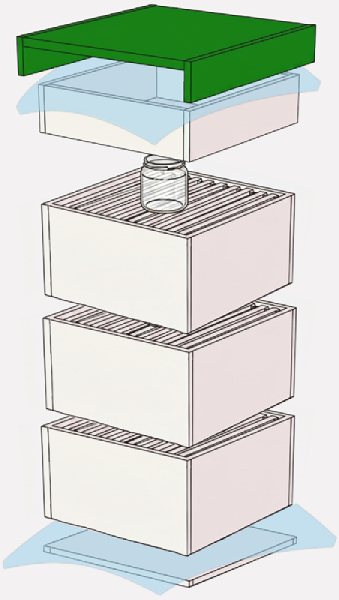
- Stack your boxes: Create a tight stack of your boxes containing the frames of drawn comb. The height of the stack is not critical; 3, 4, or 5 boxes work just fine.
- Add an empty box: Place an empty super or deep box on the very top of the stack.
- Place the acid: Inside the empty top box, resting on the frames of the box below, place a small glass or ceramic bowl (or jar).
- Dose the acid: Pour approximately 0.75 dl (2.54 fl oz) of 80% Acetic Acid into the bowl. Note: The exact amount is not overly critical; using slightly more or less is common practice and works well.
- Seal the stack: Place a sheet of plastic over the top box and seal it with a wooden sheet or a hive roof. Do the same underneath the bottom box to keep the heavy vapours inside the stack.
Over time, the acid will evaporate, and the heavy fumes will sink down through the frames, protecting the entire stack. You can leave this stack in a cold place, like a shed or garage, through the winter period.
When temperatures start to creep up during the spring, you check the level of acid in the jar. If it is low, you top it up.
Note: If you use slightly more or slightly less than 0.75 dl (2.54 fl oz) per box of 10 frames, it is likely to still be effective. I have always eyeballed these measurements and it's never failed to keep the wax moths out.
warningSafety Precautions
Important: 80% Acetic Acid is a strong, corrosive chemical.
Always handle it with care. At a minimum, the Swedish National Beekeeping Association recommends always using safety glasses and protective gloves. Some international guidelines suggest more extensive gear, such as a respirator and a rubber apron.
Use common sense and determine the safety level that is right for you, but never skip the eye and hand protection.
A Final Note on Ventilation and Equipment
The fumes are pungent. Treating your frames with acetic acid will probably make the surrounding area smell of vinegar / chemicals. It is highly recommended to perform this treatment in a well-ventilated outbuilding, shed, or a garage where you don't mind the smell.
The acetic acid vapours can also corrode non-stainless steel, and may interact with cement floors. Keep the stack of boxes on a wooden sheet or other material if you place it on a concrete or cement floor, just to be safe.
By implementing this time-tested method, you can ensure your drawn comb stays undamaged, clean, and ready for the spring buildup. Oh, and if the frames smell strongly when you take them out of storage, let them air out for a day or two before you give them back to your bees.